
A grant under the Erasmus+ Programme for Capacity Building in Higher Education 2020-2024 has been granted to Universitas Pendidikan Indonesia and other universities in Indonesia, Thailand, Malaysia, the Philippines, and Vietnam. The project concerns teacher education and civil engineering with the aim of contributing to the internationalization of higher education institutions in Southeast Asia by realizing a set of interrelated actions in three key areas with recognition mechanisms. The team members preparing the department of teacher education include Prof. Dinn Wahyudin, Faculty of Educational Sciences; Prof. Ahmad Bukhori Muslim; and Dr. Yanty Wirza, Faculty of Languages and Literature Education. Other members of the team include Prof. Vanessa Gaffar and Dr. Heny Mulyani, Faculty of Economics and Business Education. The civil engineering team comprises Dr. Juang Akbardin, Dr. Nanang Dalil Herman, Dr. Rakhmat Yusuf, Dr. Dadang M. Ma’soem, Mrs. Mardiyani, Mrs. Istiqomah, Mrs. Siti Nur Asyiah, and Mr. Odih Supratman (Faculty of Vocational and Technology Education).
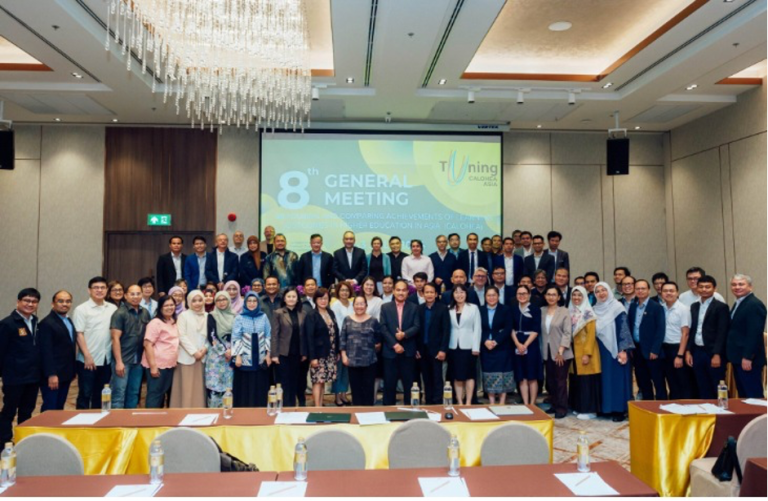
CALOHEA First General Meeting in Bangkok, Thailand in 2022
The CALOHEA Erasmus+ project has designed Regional Subject-Specific Reference Frameworks to serve as references in the recognition of degrees and study periods within the ASEAN area and between ASEAN and other regions around the world.
A Qualifications Framework is a system that actually categorizes various qualifications in a geographical area and, in general, sets out an equivalence of qualifications for example undergraduate levels across the region; it outlines knowledge, skills, attitudes, and competencies a learner will obtain upon completing that level of studies.
Regional Qualifications Reference Frameworks are intended to provide general equivalency across qualifications offered in several countries. These documents are meant to form the foundation of facilitating recognition—not to overrule a country’s national regulations or national qualification frameworks. Examples include the ASEAN Qualification Reference Framework and the European Qualifications Framework.
The CALOHEA Subject-Specific Qualifications Reference Frameworks support recognition by:
- Identifying fundamental dimensions to be addressed by each program or subject area.
- Equivalence of qualifications offered in different countries, taking into account possible differences in terminology.
- Specialization of individual programs with regard to the tackled sub-dimensions.
- Level of attainment reached by each sub-dimension with respect to knowledge, skills, or responsibilities.
- Comparability in the case of shorter periods of study in which only certain types of knowledge, skills, or kinds of responsibility are developed.
The CALOHEA Regional Subject-Specific Qualifications Reference Frameworks outline what a graduate of an ARQF Level 6 award in the fields of Civil Engineering, Medicine, and Teacher Education is expected to know, be able to do, and value, along with the relevant competencies. These facilitate recognition across all participating countries.
The CALOHEA Erasmus+ project is coordinated by the Tuning Academy of the University of Groningen, the Netherlands, and the ASEAN University Network and co-funded by the European Commission.